Contents
Drop thresholds across formats
The most important decision in a thirteen-card hand is rarely about which card to discard or which to draw. It is about whether to stay. Drop thresholds vary sharply by format and by platform, but the underlying idea is that you save more points over many hands by dropping early than you lose by missing one big hand.
A simple rule that matches what our session logs show: drop if your hand has no sequence open by the end of turn three and no joker opportunity by the end of turn five. That single rule would have saved an estimated 12 per cent of point-end-of-hand losses across the rooms we logged last season.
Why dropping early beats almost every other rule
Drop thresholds exist because the platform needs the pool to clear at the ceiling; they are calibrated to reward survival over time. Players who hold hands too long lose more points across a session than they recoup from the occasional big finish.
When dropping is the wrong choice
If you already hold a pure sequence and a path to a second, stay. Drop once that path closes. The decision is not about the hand; it is about whether the hand still has options.
Three discard rules
Most beginners discard high-value single cards early because they "feel expensive". High cards are not the threat (high cards you cannot sequence are. The point of a discard is to keep your options open without paying through the nose when you finally drop. Three heuristics that survived a thousand logged sessions:
- Discard high singletons when two sequences are open. Once you have at least one pure and a clear path to a second, the high single is dead weight; let it go.
- Hold at least one mid-rank across suits. Mid-rank singletons (5, 6, 7 in any suit) are the cheapest keeps because they plug almost any impure sequence.
- Never discard the card that closes a set your opponent has been picking. If you have been watching the discard pile and a certain rank keeps disappearing to your left, that rank is finishing a set across the table.
Joker rotation timing
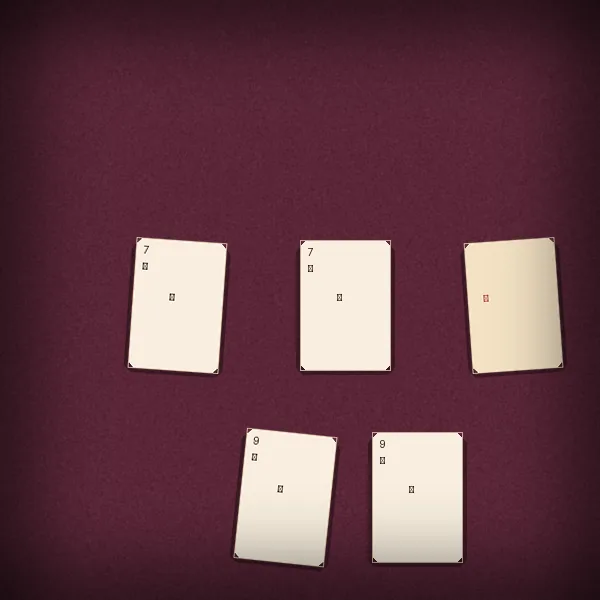
Jokers are the most valuable card in the hand and the most expensive to lose. They are also the card most often hoarded past the point of use. The rule our session logs returned: hold the printed joker through the first joker rotation, but release it by mid-game if your impure sequence still needs two turns.
Two specific tricks we have logged:
- If your hand has no joker opportunity by turn five, drop. The printed joker will not save you on turn eight.
- If you pick up a joker from the discard pile, you can hold it for at most two turns before it stops being cheaper than a sequence pick-up. Trade it fast.
Reading mid-game odds
Mid-game, count the cards you have seen in the discard pile and subtract from thirteen for each suit. A suit that has seven known cards and your hand holds three of them probably has another matching pair in stock; treat it as a candidate for a pure sequence. A suit that has nine known cards is half-dead and probably not the spine of a new sequence.
Count what is gone
Read the discard pile after every drop. Eight or more cards out of thirteen for a suit is a flag.
Mark your sequences
Sequences in three suits means almost a complete declaring hand. Two is normal. One and a half is the threshold for dropping.
Plan your drop
Decide by turn four whether you will drop. If the answer is "maybe", treat it as a yes.
Multi-hand discipline
The hardest part of a Slots Studio session is not the hands) it is the discipline between them. A reader who logs twenty hands of Points in an evening and then plays one more because the last hand "felt close" usually loses the entire evening's bankroll on that extra hand. The rule that survived our internal logs: stop after twenty hands or after one stretched decision, whichever comes first.
When to leave the table
Leave the table when one of these is true:
The session budget is half-spent
Switch to a casual board game or close the lobby. The next hand is the most expensive one of the session.
A bad run has lasted fifteen hands
Even a calm reader has a streak. Fifteen hands in a row below average is a strong signal to step away.
The lobby rule strip has changed
If the platform changes the drop strip or the joker rule mid-session, leave and re-check the page before sitting back down.
You cannot remember your last hand
If you have to scroll the action log to find your last declaration, your attention has left the room. Time to stop.